News

Sprinkling Menstrual Navigator, Centre Pompidou

Igor Štromajer: sm.N – Sprinkling Menstrual Navigator
Le Centre national d’art et de Culture Georges Pompidou, Musee national d’art moderne, Paris, France

https://www.centrepompidou.fr/cpv/resource/c6rzBdb/r6kALM

/2011/06/03/24-smn

Section of the collection : Nouveaux médias
Collection du Musée national d’art moderne
https://www.centrepompidou.fr/cpv/resource/cxq69x/rBKzjpg

cpsmn2

net.art Painters and Poets

net.art Painters and Poets
Group Exhibition
City Art Gallery, Ljubljana

19 June – 31 August 2014

nac2
net.art.mgml.si

Curated by Vuk Ćosić and Alenka Gregorič

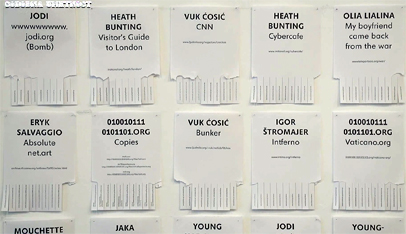
!MEDIENGRUPPE BITNIK, 0100101110101101.org, Cory Arcangel, Kim Asendorf, Mez Breeze, Cristophe Bruno, Heath Bunting, Shu Lea Cheang, Paolo Cirio, Vuk Ćosić, Constant Dullaart, Lisa Jevbratt, JODI, Justin Kemp, Olia Lialina, Alessandro Ludovico, Mouchette, Mark Napier, Evan Roth, ®TMark, Eryk Selvaggio, Alexei Shulgin, Teo Spiller, Igor Štromajer, Thomson & Craighead, Ubermorgen, Young Hae Chang Heavy Industries, Jaka Železnikar

“Why an exhibition of net.art at the Mestna galerija in Ljubljana? First and foremost, it is a matter of continuing an exhibition series that forms an important part of the program scheme: themed exhibitions that broach questions relating to how various media novelties affect the social, societal, and political paradigms of the world today.”

Igor Štromajer participating with: interno/inferno
– created: 1996
– deleted: 2011

26 files: 214 KB
– 9 HTML files
– 17 GIF files

iimglj0

Thus, two years ago we focused on the phenomenon of the global spectacle called association football. The idea was to draw parallels between two spheres that seemed worlds apart, although, as became apparent during the process of staging the exhibition, they are in reality interconnected – football and art. Last year we tackled the subject of television, a medium that has left an indelible mark on society over the past fifty years; the question underpinning the show was the impact this one-way transmitter of images has on an individual’s perception of reality. Now, as a logical conclusion or perhaps a completely new issue, we are broaching the subject of the Internet and the art related to it. Of all the exhibitions mentioned, this one likely raises the highest expectations in terms of interpretations and examination of the effect the medium has on contemporary society (especially in view of the events of recent years, think WikiLeaks and E. Snowden), yet it is also the most formalistic of all three. Formalistic in the sense of its display and the selection and presentation of the works.

naap-v

The other reason for staging an exhibition of net.art is that works presented are part of an art movement that did not occur with a delay in our country; on the contrary, artists from our geographical region actively co-created the crucial premises of this new domain in art. We need only mention a Slovenian artist pertaining to the very first generation, the so-called pioneers of net.art, Vuk Ćosić, who has also been invited to help us conceive and realize this exhibition project. A point to add is that net.art has been valued since its beginnings by the Western art world, which had in the past predominantly dictated art historical narratives.

The first floor of the gallery is homage to selected international exhibition projects, whether they were received as examples of good or bad practice. These were projects that, over time, tried out diverse approaches to presenting net.art in art institutions. This puts the underlying idea and the quintessence of such art – its distance from the established institutional art system – into a paradoxical position: it is absurd to show such art in gallery spaces. The second floor hosts works by younger-generation artists proposed by invited older-generation artists. Of course, the works produced by this generation of artists have originated in a different Internet environment than the works of their predecessors, and pertain, for the most part, to what theory has named post-Internet art or Internet-aware art.

Alenka Gregorič

Masaža ega – Press

Izbrani medijski zapisi o razstavi Masaža ega v Projektnem prostoru Aksioma:

– Petra Tanko, Radio Slovenija, Program Ars, Razgledi in razmisleki, 5. junij 2014
“Pogovor z Igorjem Štromajerjem”

– Maša Levičnik, Televizija Slovenija, Kultura ob 22h, 15. maj 2014
“Igor Štromajer: Masaža ega”

– Jela Krečič, Delo, Kultura, 20. maj 2014
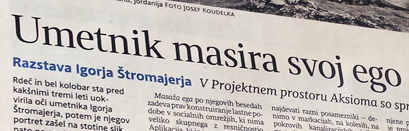
“Igor Štromajer masira svoj ego”

– Neža Mrevlje, SiOL, Kultura, 25. maj 2014
“Igor Štromajer: Kadar se toliko ukvarjaš sam s sabo in potiskaš vse na rob mogočega, je to vulgarno”

pp01234565789

– Bojan Stefanović, Radio Študent, 26. maj 2014 (od 28. minute naprej)
ART-AREA 234

Continue reading “Masaža ega – Press”

Aksioma | Ego Massage

Aksioma – Institute for Contemporary Art, Ljubljana,
presents:

Igor Štromajer
EGO MASSAGE
(Ceci n’est pas de l’art)
Solo Exhibition

Aksioma | Project Space
Komenskega 18, Ljubljana

14 May – 13 June 2014

Exhibition: www.aksioma.org/oo
Project: www.intima.org/oo

Exhibition opening and lecture by Constant Dullaart: 14 May 2014 at 8 pm
ema-01

+ Flickr Album by Aksioma

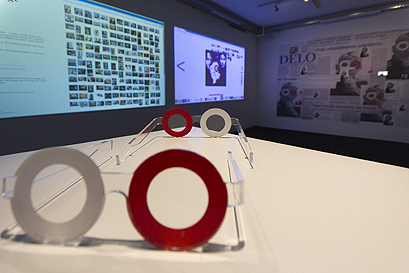
At a time when the Internet has become, as it were, dead code on screen, because giant corporations have usurped and radically transformed its initial idea; when even philosophy, social theory and media studies indicate that a true, radical future exists outside the Internet (“The future is offline.” Cf. the studies of Steven Shaviro, Professor at Wayne State University in Detroit, and Jussi Parikka, Professor at Winchester School of Art, University of Southampton); when we live in a so-called post-media reality – at such a time, the questions of virality and self-virality, transposition, constant translation, emptiness and repetitiveness, representation and identity are the key questions. With the exhibition Ego Massage, we tackle these questions directly. Ego Massage raises complex topical questions of translation of the digital into the analogue; far from exploiting the popularity of the concept of Internet meme, it takes a step further, returning memes to the real world, back to its biological (genetic) context.

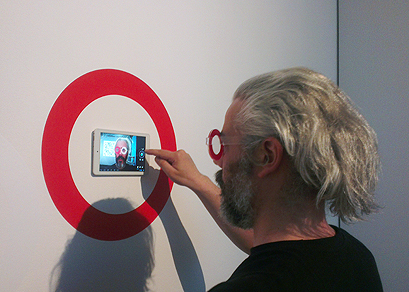
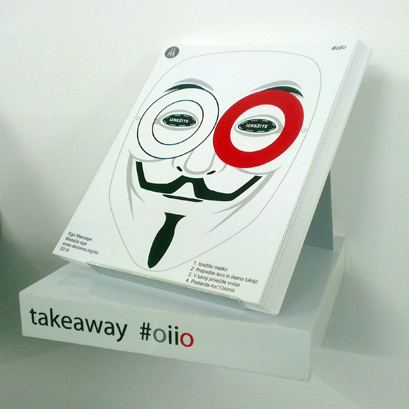
Ego Massage is an urban performance and an installation project that attempts to transpose virality, social networking, memes and other contemporary web phenomena from the online public space to the offline public space, and from there to the exhibition space.

A while ago, artist Igor Štromajer introduced as his profile picture in all his social networks his own portrait with two circles (one red and one white) around his eyes. The resulting image was stylised, clear and instantaneously recognisable: perfect for viral diffusion. The author edited this profile picture into several hundreds of other photographs available online using automated web logarithms, services that facilitate quick, instantaneous photomontage. Mimicking the forms of diffusion of popular online media, the artist generated an “artistic meme”, that brought about not only the viral circulation of his own images, but also the spontaneous imitation and variation of his signature practice, with people editing these circles into their own profile pictures. (www.intima.org/ego-massage)

ema-02

A meme is an idea, a form of behaviour or a style, which, within a certain cultural practice, spreads from one user to another. It works as a unit for the implementation of cultural ideas, symbols or practices that can be transmitted through writing, images, speech, gestures, rituals or other imitative phenomena. As a cultural phenomenon, a meme represents an analogy to human genes – it reproduces itself, it mutates and is therefore quick to respond to topical events. Although memes preexisted the Internet – some people say that memes are just the way our culture works – the Web has proven to be an extraordinary platform for the spreading of memes.

During the exhibition, the gallery will function as the headquarters of the public space intervention, and at the same time as the temporary folder where the idea is materialized and explained through hundreds of Štromajer’s selected and printed photomontages, where documentary material is collected and put on display, and where the awareness of the audience is enhanced with educational activities.

The opening of the exhibition will be accompanied by the presentation of Dutch intermedia artist Constant Dullaart, who also explores in depth the transitions from the Web into the real space and various forms of online and offline meme-performance.
ema-03

Production:

Aksioma – Institute for Contemporary Art, Ljubljana, 2014

Artistic Director: Janez Janša
Producer: Marcela Okretič
Executive Producer: Sonja Grdina
Public Relations: Mojca Zupanič
Technician: Valter Udovičić
Documentation: Adriana Aleksić

The programme of Aksioma Institute is supported by the Ministry of Culture of the Republic of Slovenia and the Municipality of Ljubljana.

Sponsor: Datacenter d.o.o.

CONTACT
Aksioma | Institute for Contemporary Art, Ljubljana
ema-04

Totalka

Totalka
večer intermedijskih umetnosti
Trubarjeva hiša literature, 13. maj 2014 ob 19h

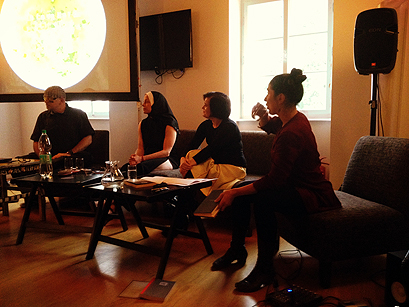
Umetnici in umetnik umetno o umetnosti: Irena Tomažin, Leja Jurišić in Igor Štromajer o teoriji ljubezni, davčni zaroti in pregibni ekonomiji.

Resnica ni nikoli ena sama, resnice so (vsaj) tri. Besedni troboji s krmarko, s pridihom perfomativne improvizacije. Totalka, do dna, brez možnosti vračila – vsak zase, vendar vsi trije zelo skupaj. Pogovor bo vodila in usmerjala Semira Osmanagić iz Oddelka za kulturo MOL.

truhl

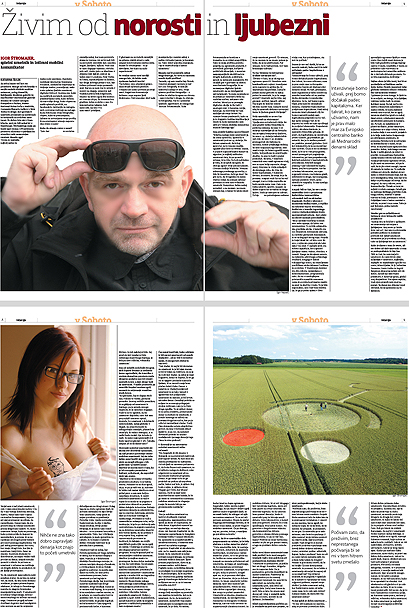
Večer: Živim od norosti in ljubezni

Večer: Živim od norosti in ljubezni

isvsp-wp

Katarina Šulek, Sobotna priloga, Večer, 3. maj 2014

BOMB 2014

BOMB Magazine
NYC, April 21, 2014

Annie Abrahams, Gretta Louw and Igor Štromajer about Annie Abrahams, Gretta Louw and Igor Štromajer. A three-way conversation about performance art online.

bmb

Art : Interview / BOMB — Artists in Conversation

#

Delo: Najsrečnejši umetnik na svetu

Jelka Šutelj Adamič, Delo, Kultura, 2. april 2014

EatingMy#Self[ie]

Ajda Tomazin & Igor Štromajer: EatingMy#Self[ie]
– public space video (17′ 48″ / loop)
Frankfurt, 2014

YouTube version

#