Make Love, Not Art.
by Igor Štromajer
[Selected Press Links]
Por: Roberta Bosco y Stefano Caldana
El Pais, 12 de marzo de 2012


Make Love, Not Art.
by Igor Štromajer
[Selected Press Links]
Por: Roberta Bosco y Stefano Caldana
El Pais, 12 de marzo de 2012
Igor Štromajer
Make Love, Not Art.*
* Jebe & #353; umetnost.
Prevod: Jure Novak
Exhibition: Expunction
Flickr Aksioma | Flickr Expunction | Facebook | Twitter
www.intima.org/expunction @ Aksioma Project Space
Ljubljana, Slovenia, March 2012
Exhibition opening: Wed, 29 February 2012 at 7 PM
29 February – 16 March 2012
Theoretical and conceptual contextualization: Ida Hiršenfelder, Digital Death
ENG: www.aksioma.org/make_love_not_art
SLO: www.aksioma.org/make_love_not_art/index_slo.html
↓


Photo: Janez Janša, Aksioma

– sporočilo za medije (PDF)
– Press Release (PDF)
transmediale 2k12 | 31 January – 5 February 2012
in/compatible
Haus der Kulturen der Welt, Berlin
transmediale 2012 | www.transmediale.de/content/webvideo-new-netart:
Wednesday, 1 February 2012
15:00 – 17:00
25 years of transmediale | web video – the new net art? | panel with Robert Sakrowski, Constant Dullaart, Petra Cortright, Igor Štromajer
↓
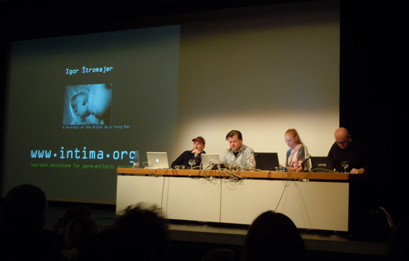
Photo: Brane Zorman
If net art is cashing in on the utopian promise of video art, what dream does net art have left for itself? Has it come full circle? Is net.art now at its end? And is it true what the net art veteran Mark Amerika proclaims via Twitter, that “video is the new net art”?

Photo: Brane Zorman
Perhaps the confusion in the question stems from a too-narrow understanding of net art thanks to the label “net.art”, which usually refers only to a small group of artists of a particular time (1995-1999). Such a designation could never really be adequate to the phenomenon of net art, because, like photography, painting, or video art, it is an art form – and art forms are above all defined by their medium. The medium of net art, however, is simply the net: whichever particular form net art takes is irrelevant for its definition. Whether its clients are connecting to the net using stationary computers with browsers or mobile devices with apps, whether their bandwidth speed is fast or slow – “net art will never die!”; since a society without the net is itself now inconceivable (just as it once was without the printing press).
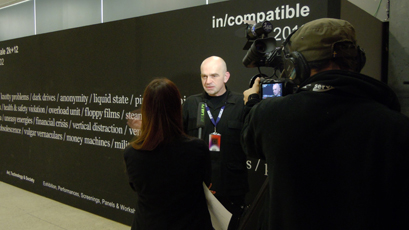
Photo: Brane Zorman
Continue reading “transmediale 2012: web video – the new net art?”
b.ALT.ica
net art work by Igor Štromajer (1998)
is part of the
<collaborative documenting / archiving of netart.activities>
transmediale 2012 installation by Constant Dullaart and Robert Sakrowski
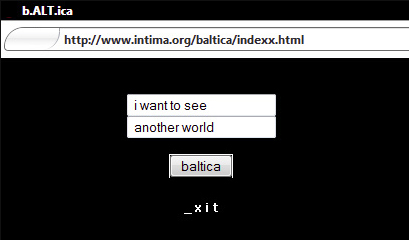
b.ALT.ica (1998–2011) | 169 files: 3.24 MB
Created by Igor Štromajer | Produced by Intima Virtual Base
Courtesy of Moderna galerija Ljubljana – Slovene Museum of Contemporary Arts, Ljubljana, Slovenia
Awarded: 5.000 DM (West German Marks) at COMTECart 99 / CYNETart festival, Dresden, Germany, 1999 (Kunsthaus Dresden and Medien- und Kulturzentrum Pentacon, Dresden); Curator: Klaus Nicolai
First presented at transmediale.99 (Podewill, Berlin, 1999)
b.ALT.ica Expunction | b.ALT.ica Flickr
b.ALT.ica is dedicated to my father, because this is the place where he lives now. | Franjo Štromajer , 1943–1997
↓

<collaborative documenting / archiving of netart.activities>
#tm2k12 installation by Constant Dullaart and Robert Sakrowski

Art Laboratory Berlin
Saturday, 14 January, 2012
3.30 PM: Tour of the exhibition Controlling_Connectivity with Gretta Louw and Regine Rapp (curator)
4 PM: Artists’ talk Current Artistic Practices on Time and Technology with Gretta Louw, plan b (Sophia New & Daniel Belasco Rogers) and Igor Štromajer; moderation: Christian de Lutz (curator).
In connection with the exhibition Controlling_Connectivity by Gretta Louw and the series Time and Technology Art Laboratory Berlin is presenting an artists’ talk on the theme current art practices on time and technology featuring Gretta Louw and plan b (Sophia New & Daniel Belasco Rogers) as well as the internet artist Igor Štromajer (www.intima.org). The talk will be introduced and moderated by Regine Rapp and Christian de Lutz.
Continue reading “Current Art Practices on Time and Technology”
“Le Slovène Igor Stromajer va plus loin avec Expunction, où il a mis en scène, de mai à juin, la suppression de ses œuvres en ligne devenues inactives, qu’il démonte en expliquant leur création et leur environnement technique. Elles sont ensuite mises à disposition dans une archive téléchargeable. La création est là conservée mais tronquée, isolée du monde virtuel auquel elle répondait.”
http://www.liberation.fr/culture/01012380557-au-portail-du-musee
Au portail du musée
Par Sophian Fanen, Liberation, 31. décembre 2011
“À suivre”: capturer le temps dans la performance contemporaine
Les Laboratoires d’Aubervilliers
The dance theorist Bojana Kunst is spending weeks with a choreographer, artist, or other cultural producer (Danae Theodoridou, performer and researcher, Boyan Manchev, philosopher and theorist, Ivana Müller, choreographer, Igor Štromajer, internet artist), exploring the different aspects of work processes within contemporary art, their relationship to time and the political, economic and performative implications of such experimentation. These “full-time” meetings are being shared with the public, either during conversations, performance, or by individual appointment. These occasions offer to the public the opportunity to engage themselves with the ways Bojana Kunst and her partners address their relationships to time. The material produced during these meetings and public situations provides the basis for a publication, to appear in 2012.
↓
Meeting with Bojana Kunst and Igor Štromajer
Saturday, 17 December 2011, encounter between Bojana Kunst and Igor Štromajer
Live Internet Broadcast:
www.ustream.tv/channel/les-labos
Saturday, 17 December, 16:00 – 19:00 (CET +0100 UTC; Paris Time)
+ ask questions via Twitter, use #explab hashtag.
↓

On May 2011 Igor Štromajer started to delete his net art projects, created from 1996 to 2007 (Expunction, 2011). The process of deletion opened many questions about temporal fragility of contemporary artistic practice, especially when we talk about new media art works. You are invited to join us at the encounter, where we would like to talk about the disappearance of projects and their temporal traces, about the attempts to keep the projects going on or to delete them, transfer them or archive them, to keep them or to leave them going.
↓

↓
Appointments on Saturday, 17 December 2011, 4 pm – 7 pm.
Contact Virginie Bobin to set up a meeting, at v.bobin@leslaboratoires.org and +33 153 561 594.
Les Laboratoires d’Aubervilliers
41, rue Lécuyer, 93300 Aubervilliers, France
Transmittance #2
Telematic performance by Maja Delak & Luka Prinčič / Wanda & Nova deViator.
13 December 2011 at The Gallery 001, Tobačna Factory, Ljubljana
+ live online!
Igor Štromajer participating as: Online Agent
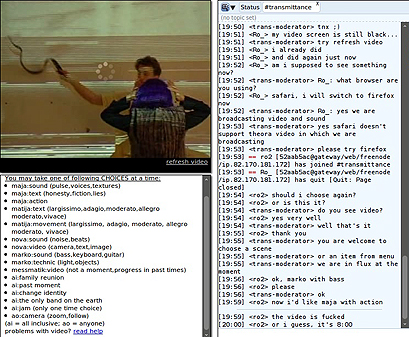
Transmittance explores collaboration which is local, global, networked and broadcasted. It involves an artistic group of performers, visual artists, musicians and computer programmers to research performative possibilities of streaming, broadcasting and telepresence forging new types of performance and audience. With focus on critical and socially-aware artistic languages this work is based on asking questions about body, self and society – opening non-dualistic perspectives.
Transmittance is available as research, educational and/or performance model including a preparation time and performance event that is streamed on-line.
Production: Emanat
Visit our blog and Projects/Transmittance for more.
Digital Art Conservation: Practical Approaches
Artists, Programmers, Theorists
École supérieure des arts décoratifs de Strasbourg, 24 and 25 November 2011, 09.00–18.30
FR | DE + Download the programme booklet and the poster (PDF)
24 Nov 2011 at 16:15 | Igor Štromajer presenting: Expunction (Deleting http://www.intima.org Net Art Works, May – June 2011)

Artists who create digital artworks face the problem of preservation much sooner than artists who work with more traditional materials. Artists who wish their work to endure always ready for exhibition, must give some thought to preservation strategies from the moment the artwork is created. The choices of standard tools, documentation and modes of distribution are all part of this process.
An interest in the historical value of digital artworks also encourages the institutions that exhibit them to make this particular value visible, in addition to the appropriate conservation of the work. This leads us to reconsider the conservation strategies which advocate the systematic and continuous updating of non-functioning or obsolete devices.
This symposium aims to give an overview of certain strategies that have been implemented over the past few years by presenting the intertwined approaches and practices of theorists, artists, programmers and preservation specialists.
 intima.org · Igor Štromajer