Subversive Systems

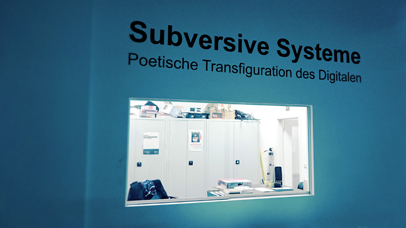
Subversive Systems. Poetic Transfiguration of the Digital
Subversive Systeme. Poetische Transfiguration des Digitalen
Group Exhibition

Stadtgalerie Mannheim, Germany

sgml

Opening: 23 October 2014 at 7pm
24 October – 30 November 2014
Curator: Benedikt Stegmayer

Artists: Annie Abrahams, [epidemiC] / Franco Berardi, plan b, Volker Hartmann-Langenfelder, Igor Štromajer

susi-00
+ FB Photo Album

Igor Štromajer participating with

zero/0 tolerance (Frankfurt 2014):

mannheim-1

Ballettikka Internettikka (Internet 2001-2011) Remix (I. Štromajer & Brane Zorman):

mannheim-2

Expunction / Deleting Net Art Works (Hamburg 2011):

mannheim-3


Die Stadtgalerie Mannheim zeigt vom 24. Oktober bis 30. November 2014 in S 4, 17 die Gruppenausstellung „Subversive Systeme. Poetische Transfiguration des Digitalen“ mit Kunstwerken von Annie Abrahams, [epidemiC], Volker Hartmann-Langenfelder, plan b und Igor Štromajer. Die Ausstellungseröffnung findet am 24. Juli um 19 Uhr statt.

sys24

Die aktuelle Gruppenschau der Stadtgalerie Mannheim widmet sich der Netz-Kunst und ihren Pionieren. Das Internet ist als Medium immer noch sehr neu. Seine Entwicklung verläuft aber so rasant, dass selbst vergleichsweise junge Internetphänomene technisch bereits längst überholt sind und kurios anmuten. Dasselbe gilt für die Mobiltelefonie und ihre Entwicklung. Umso erstaunlicher ist die Ausstellung in der Stadtgalerie Mannheim, die zeigt, wie souverän Künstlerinnen und Künstler das Medium nutzen und nutzten – und wie früh sie sein ästhetisches Potenzial erkannten.

sys23

Die Übersetzung von Digitalem in Analoges ist ein Prinzip, mit dem Künstlerinnen und Künstler versuchen, die Wahrnehmbarkeit von abstrakten Phänomenen zu erweitern und für Menschen direkter erfahrbar zu machen. In der Performance „loveLetter.vbs reading“ lässt die italienische Netzkunstgruppe [epidemiC] den Philosophen Franco Berardi den Quellcode des Viruses vorlesen, der sich ab dem 4. Mai 2000 explosionsartig verbreitetet und einen geschätzten Schaden in Höhe von 10 Milliarden US Dollar anrichtete.

Das Künstlerpaar plan b druckt ihren gesamten privaten SMS-Verkehr eines Jahres während der Laufzeit der Ausstellung auf Endlospapier aus. In einer Performance während der Ausstellung lesen sie sich diese Nachrichten vor.

Das gegenteilige Prinzip wenden Annie Abrahams und Igor Štromajer in ihren Arbeiten an. Sowohl Štromajers und Zormans „Ballettikka Internettikka“ als auch Annie Abrahams „The Big Kiss“ verwenden die Digitalisierung, um klassische Performances zu verändern und zu komplettieren. Štromajers und Zormans „Ballettikka Internettikka“, eine Serie von Performances, die er zwischen 2001 und 2011 durchführte, arbeitete bereits zu Beginn mit dem mobilen Internet – und kam dadurch besonders in den ersten Jahren sehr schnell an seine technischen Grenzen, die in die Arbeit integriert wurden.

Volker Harmann-Langenfelders Arbeit „Beep! For an unspecified number of mobile devices in an unspecified room.“ bewegt sich im Zwischenbereich. Der Künstler übersetzt experimentelle, aleatorische Musik in eine digitale Form. Die Arbeit besteht jedoch aus einem QR-Code, der mit Smartphones bzw. Tablets und den entsprechenden Anwendungen ausgelesen werden kann und den Systemton des Geräts wiedergibt.

Stadtgalerie Mannheim
S 4, 17
68159 Mannheim
(0621) 293 3782
Öffnungszeiten: Do-So, 12-18 Uhr
www.stadtgalerie-mannheim.de

Open Call

myoa-wp

n2syb-wp

pictfr

Igor Štromajer
www.intima.org

Sprinkling Menstrual Navigator, Centre Pompidou

Igor Štromajer: sm.N – Sprinkling Menstrual Navigator
Le Centre national d’art et de Culture Georges Pompidou, Musee national d’art moderne, Paris, France

https://www.centrepompidou.fr/cpv/resource/c6rzBdb/r6kALM

/2011/06/03/24-smn

Section of the collection : Nouveaux médias
Collection du Musée national d’art moderne
https://www.centrepompidou.fr/cpv/resource/cxq69x/rBKzjpg

cpsmn2

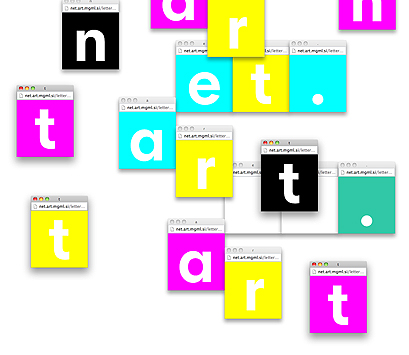
net.art Painters and Poets

net.art Painters and Poets
Group Exhibition
City Art Gallery, Ljubljana

19 June – 31 August 2014
nac2
net.art.mgml.si

Curated by Vuk Ćosić and Alenka Gregorič

!MEDIENGRUPPE BITNIK, 0100101110101101.org, Cory Arcangel, Kim Asendorf, Mez Breeze, Cristophe Bruno, Heath Bunting, Shu Lea Cheang, Paolo Cirio, Vuk Ćosić, Constant Dullaart, Lisa Jevbratt, JODI, Justin Kemp, Olia Lialina, Alessandro Ludovico, Mouchette, Mark Napier, Evan Roth, ®TMark, Eryk Selvaggio, Alexei Shulgin, Teo Spiller, Igor Štromajer, Thomson & Craighead, Ubermorgen, Young Hae Chang Heavy Industries, Jaka Železnikar

“Why an exhibition of net.art at the Mestna galerija in Ljubljana? First and foremost, it is a matter of continuing an exhibition series that forms an important part of the program scheme: themed exhibitions that broach questions relating to how various media novelties affect the social, societal, and political paradigms of the world today.”

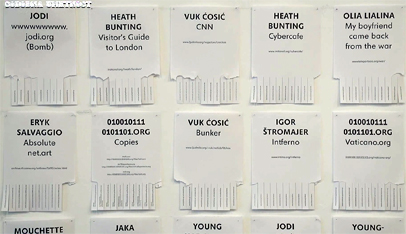
Igor Štromajer participating with: interno/inferno
– created: 1996
– deleted: 2011

26 files: 214 KB
– 9 HTML files
– 17 GIF files

iimglj0

Thus, two years ago we focused on the phenomenon of the global spectacle called association football. The idea was to draw parallels between two spheres that seemed worlds apart, although, as became apparent during the process of staging the exhibition, they are in reality interconnected – football and art. Last year we tackled the subject of television, a medium that has left an indelible mark on society over the past fifty years; the question underpinning the show was the impact this one-way transmitter of images has on an individual’s perception of reality. Now, as a logical conclusion or perhaps a completely new issue, we are broaching the subject of the Internet and the art related to it. Of all the exhibitions mentioned, this one likely raises the highest expectations in terms of interpretations and examination of the effect the medium has on contemporary society (especially in view of the events of recent years, think WikiLeaks and E. Snowden), yet it is also the most formalistic of all three. Formalistic in the sense of its display and the selection and presentation of the works.
naap-v

The other reason for staging an exhibition of net.art is that works presented are part of an art movement that did not occur with a delay in our country; on the contrary, artists from our geographical region actively co-created the crucial premises of this new domain in art. We need only mention a Slovenian artist pertaining to the very first generation, the so-called pioneers of net.art, Vuk Ćosić, who has also been invited to help us conceive and realize this exhibition project. A point to add is that net.art has been valued since its beginnings by the Western art world, which had in the past predominantly dictated art historical narratives.

The first floor of the gallery is homage to selected international exhibition projects, whether they were received as examples of good or bad practice. These were projects that, over time, tried out diverse approaches to presenting net.art in art institutions. This puts the underlying idea and the quintessence of such art – its distance from the established institutional art system – into a paradoxical position: it is absurd to show such art in gallery spaces. The second floor hosts works by younger-generation artists proposed by invited older-generation artists. Of course, the works produced by this generation of artists have originated in a different Internet environment than the works of their predecessors, and pertain, for the most part, to what theory has named post-Internet art or Internet-aware art.

Alenka Gregorič

Totalka

Totalka
večer intermedijskih umetnosti
Trubarjeva hiša literature, 13. maj 2014 ob 19h

Umetnici in umetnik umetno o umetnosti: Irena Tomažin, Leja Jurišić in Igor Štromajer o teoriji ljubezni, davčni zaroti in pregibni ekonomiji.

Resnica ni nikoli ena sama, resnice so (vsaj) tri. Besedni troboji s krmarko, s pridihom perfomativne improvizacije. Totalka, do dna, brez možnosti vračila – vsak zase, vendar vsi trije zelo skupaj. Pogovor bo vodila in usmerjala Semira Osmanagić iz Oddelka za kulturo MOL.

truhl

Artist Talk

a=tF²
To find the art, you multiply the time by the square of the force

– Artist Talk / Public Lecture Presentation by Igor Štromajer

Centre for Creative Arts
School of Communication, Arts & Critical Enquiry
La Trobe University, Melbourne, Australia
Thursday, March 20th 2014

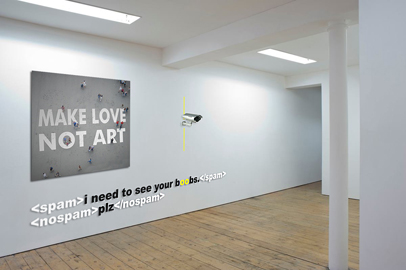
Make Love Not Art

Renowned media artist Igor Štromajer to talk at La Trobe

NET.ARTography, Group Exhibition

LOOK INTO THE NET

NET.ARTography, Group Exhibition
Edith Russ Site for Media Art, Oldenburg, Germany
7 March – 21 April 2014
Curated by Gustavo Romano

Catalog PDF

Artists:

0100101110101101.org (Eva & Franco Mattes); Ivan Abreu; Amy Alexander; Marcel·lí Antúnez; Kim Asendorf; Lucas Bambozzi; Ryan Barone; Giselle Beiguelman; Amy Berk; Luther Blissett; Natalie Bookchin; Christophe Bruno; Maite Cajaraville; Martin John Callanan; Azahara Cerezo; Paolo Cirio; Arcángel Constantini; Vuk Cosic; Andy Cox; Critical Art Ensemble; Minerva Cuevas; Young-Hae Chang; Santiago Echeverry; Vadim Epstein; Evru; Fiambrera Obrera; Gonzalo Frasca; Belén Gache; Dora García; Daniel García Andújar; Gazira Babeli; Emilio Gomáriz; Ethan Ham; Luis Hernández Galván; Robin Hewlett; Steev Hise; Ricardo Iglesias; Daniel Jacoby; Sergi Jordá; Scott Kildall; Ben Kinsley; La Société Anonyme (José Luis Brea); Joan Leandre; Les Liens Invisibles; Olia Lialina; Rogelio López Cuenca; Iván Lozano; Alessandro Ludovico; Peter Luining; Fernando Llanos; Brian Mackern; Miltos Manetas; Rafael Marchetti; Iván Marino; Antonio Mendoza; Ricardo Miranda Zúñiga; Antoni Muntadas; Mark Napier; Eduardo Navas; Santiago Ortiz; Christian Oyarzún; Paolo Pedercini (Molleindustria); Raquel Rennó; Ricardo Barreto & Paula Perissinotto; Gustavo Romano; Benjamin Rosenbaum; Mario Santamaría; Santo_File (David Casacuberta & Marco Bellinzoni); Mark Shepard; Alexei Shulgin; Mark Skwarek; Darren Solomon; Stanza; Nathaniel Stern; Igor Štromajer; Taller d’Intangibles (Jaume Ferrer & David Gómez); Philipp W. Teister; The Electronic Disturbance Theater; The Yes Men; Thomson & Craighead; Eugenio Tisselli; Ubermorgen; Sander Veenhof; Elo Vega; Angie Waller.

The works shown in this exhibition of the internationally most relevant net artists belong to the collection of NETescopio, iniciated in 2008 and since then constantly developed by the Spanish Museum of Contemporary Art of Extremadura and Latin America – MEIAC, Badajoz. With NETescopio, the MEIAC is a pioneer in the availability of an Internet accessible art collection beyond the physical presence of the actual Museum. A selection of 120, partly no longer accessible, key works covers the panorama of net art production from the 1990s until today. This exhibition is in this sense a unique opportunity to gain an insight into the net art tendencies and their aesthetics. The main objective of the NETescopio archive, which makes also a historical classification of the collected works, is the preservation of the works, characterized by the incorporation of a large numbers of Spanish and Latin American net artists.

The curator Gustavo Romano has distinguished three strategies of artistic appropriation of the Internet with their various formats:

Disassemblings

During the web´s early years the artists started to experiment with the new medium and dealt with the possibilities of interactivity, the use of interfaces and alternative browsers. It is in the first years of web art, which can be seen in this category, that show a greater radicalism with a stress on experimentation and the deconstruction of the medium.

Re/appropriations

The reuse of symbolic materials and artistic reactions to existing content play a key role in this work. In digital media information can be reproduced and manipulated, developing constant mutation. This poses in discourses to copy, original and authorship, as well as to owner and collector of net art. The artist’s role on the web is of a “redirector” of information.

Intrusion

These works refer to artistic intervention in a new public space, the “Internet”, which involve commonly used sites such as Wikipedia or Google Maps, which parody or subvert private pages, in order to undermine them through artistic contexts. Stealthily infiltration of the user’s computer or other computer systems is discussed here. The artist slips here into the role of spies, intruders and solitary flaneurs.

losdf6765

Igor Štromajer participating with:
re:volution
online project, 1997 – 2011

Characterised by aesthetics which evoke a post-Cold War era in which the side-effects of that war continue to be present on the Internet, re:volution offers itself to us as a machine, a platform for the public to use to comfortably drive the revolution. This is a revolution which, according to the words of our guide, a child named GTA (Great Teacher and Astronaut), has still not been successful, and for which we must keep fighting, armed with out powerful new weapon of war: e-mail.
The project is full of media and consumer icons, political icons from a nostalgic modern era today transformed into clip art, which circulate like devalued information on the Internet. The re-combination of these materials seems to reveal the decadence of power to us: far from those grand speeches and monumental events, they are reduced to tiny 8-bit files.

571gr976

Continue reading “NET.ARTography, Group Exhibition”

Social Networks as Platforms for Media Art

Social Networks as Platforms for Media Art
– Media Art and Digital Culture Workshop with Igor Štromajer / Masterclass

Centre for Creative Arts
School of Communication, Arts & Critical Enquiry
La Trobe University, Melbourne, Australia
Tuesday March 18th 2014

DE.fragmentation/GRO

DE.fragmentation/GRO

GRO Gallery
FB: GRO galleri, Campus Allegro
Jakobstad, Finland

Exhibition
14 March – 13 April 2014

Artists: Florian Grond, Stefano Marotta, Roberto Russo, Irena Pivka, Brane Zorman, Arjan Pregl, Marcin Ramocki, Christian Rupp, Owen Smith, Igor Štromajer, Joakim Hansson, Tom Kerševan, Jurij Pavlica, Sendi Mango.

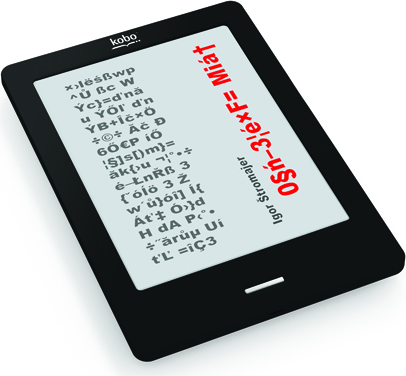
Igor Štromajer‘s 0§n–3¦é×F= Miᆠexhibited at the GRO Gallery, Finland.

Defragmentation is a term which comes from technology. More specifically, it is related to the computer data storage system and concerns the process of rearranging data in order to speed up data retrieval. Upon reflection, this type of optimization simply means a more efficient use of the potential of such a device. Potential is not just something that is planned as part of the product design, it has a maximum, finite value. It is based on specific parameters, and determined only by existing needs and inventiveness/creativity. By rearranging data on the computer disk, thereby taking into consideration the device’s environment and record history, we create new electrical states, which mean a better device and progress in relation to the previous state.

g1

+ Photos from the opening

The time and space which contemporary art occupies and in which it manifests itself also has potential of its own. The artist applies his or her creativity to rearrange it into different abstract and material structures. It draws upon a limited space and time for the sole reason of causing change in a given and opportune moment. This change is not irrelevant because it signifies progress. In the context of the showcased artworks and artists, defragmentation is therefore a word which highlights the process as something which necessarily improves on the previous state, an invention, art.