MoTa Museum of Transitory Art
14 February 2014, 8 PM
MoTa Valentine’s Kitchen
– dinner with the artist: Igor Štromajer, Make Love Not Art, projection


MoTa Museum of Transitory Art
14 February 2014, 8 PM
MoTa Valentine’s Kitchen
– dinner with the artist: Igor Štromajer, Make Love Not Art, projection
Pixxelpoint Festival 2013
De.fragmentation
Nova Gorica, 29 November – 6 December 2013

Igor Štromajer‘s 0§n–3¦é×F= Miᆠexhibited at the Nova Gorica City Gallery.
Pixxelpoint 2013 Artists:
Primož Bizjak, Mark Durkan & Eilis McDonald, Florian Grond, Kensuke Koike, Marotta & Russo, Anja Medved, Jani Osojnik, Project59 (Irina Danilova, Hiram Levy, Dan Tuvlosky), Marcin Ramocki, Martin Romeo, Christian Rupp, Lena Lieselotte Schuster, Sašo Sedlaček, Owen F. Smith, Maja Smrekar, Igor Štromajer, Miha Turšič, Špela Petrič, Maja Murnik, Visoka šola za umetnost Univerze v Novi Gorici, Workshops with Pamela Barberi
+ PDF Catalog (Eng/Slo)
Selection:
BridA / Tom Kerševan, Sendi Mango, Jurij Pavlica
+ Pixxelpoint 2013 on Facebook
Curating Your Memory
Curating Your Memory is an evening about deleting, curating and dealing with big data on a personal scale.
V2_ Institute for the Unstable Media, Rotterdam
The Piet Zwart Institute, Rotterdam
V2_: Thursday, 28 November 2013 at 8 pm
French philosopher Jacques Derrida made the claim that ‘the mutation in technology changes not simply the archiving process, but what is archivable – that is, the content of what has to be archived is changed by the technology’. What he means is that the style of the content is transformed through new processes and production. Moreover, the relation to time and space created by the fact that within mere seconds one can reach someone in every corner of the world, has also affected the content. Of course this also effects power relations, decision-making and accountability. It is generally known and accepted that archives construct a specific account of history, many things end up in an archive, but even more remains outside, to be forgotten. Questions like who is in charge of an archive, who selects, and for whom is the archive, have been plaguing archives from the beginning. One could argue that the digital accelerates this process, so how to relate to this new situation? What is the value of digital memory and how to deal with big data on a small scale? These questions form the start of an evening with three perspectives.
With Robert Sakrowski, Dragan Espenschied and Igor Štromajer, moderated by Annet Dekker.
This public event is organised by Piet Zwart Institute, Dept of Media Design – Networked & Lens-Based, and made possible with the support of Goethe Institute and V2_.

Igor Štromajer presenting at the V2_ Institute for the Unstable Media, Rotterdam, 28 Nov 2013, Photo: Sakrowski
Igor Štromajer:
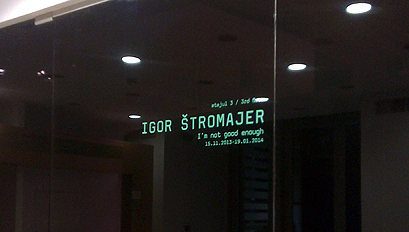
I Am Not Good Enough / Nu sunt suficient de bun
Artist Talk / Solo Exhibition
National Museum of Contemporary Art, Bucharest, Romania
MNAC – Muzeul National de Arta Contemporana
15 November 2013 – 15 January 2014
English: www.mnac.ro/en/archives/3493
Romanian: www.mnac.ro/archives/3493

↓


Production: Alina Bucur
MNAClab: Larisa Sitar
Un acuerdo que materializa lo virtual
Por: Roberta Bosco y Stefano Caldana
04 de noviembre de 2013
El Pais, El arte en la edad del silicio, Madrid, Spain
(authors write also about the work of Igor Štromajer)
↓
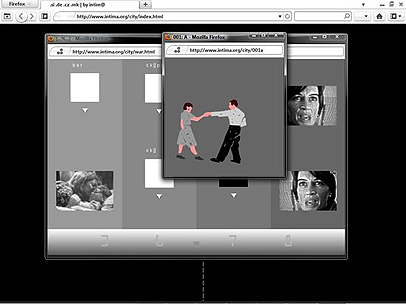
Colección Reina Sofía. “What was he thinking about? berlin? praha? ljubljana? skopje?” (2000) de Igor Štromajer.
+ read the entire article (in Spanish): blogs.elpais.com/arte-en-la-edad-silicio/2013/11/un-acuerdo-que-materializa-lo-virtual.html
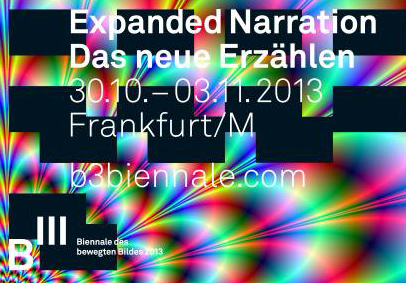
B3 Moving Image Biennial / Biennale des bewegten Bildes
30 October – 3 November 2013, Frankfurt, Germany
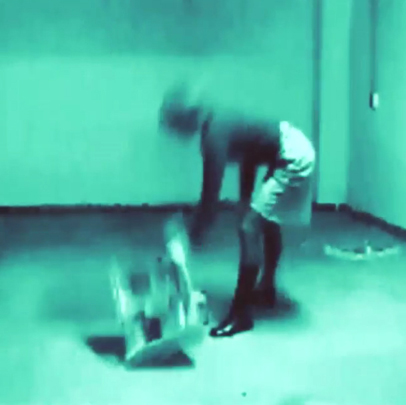
2nd winner: Instagram video Love Without Mercy / Liebe ohne Gnade by Igor Štromajer (category Expanded Narration / Ultrashort)
B3 Ultrashot Jury:
– Frédéric Boyer (Artistic Director of the Tribeca Film Festival, New York)
– Eva Paulitsch and Uta Weyrich (Artists)
– Prof. Bernd Kracke (Professor for Electronic Media, President of the Hochschule für Gestaltung – HfG / University of Art and Design Offenbach, Head of the B3 Biennale)
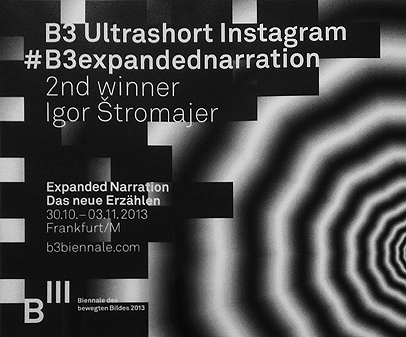
– Award / (The Prizes of the B3)
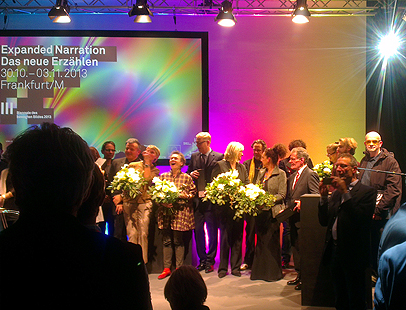
Award ceremony: on stage with Laurie Anderson, 3 November 2013, Frankfurter Kunstverein.
Photo: Ajda Tomazin
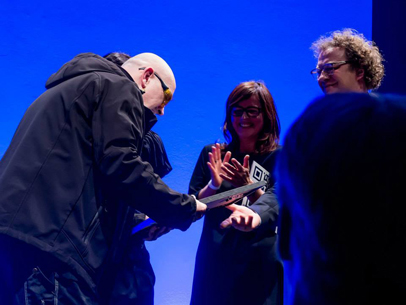
Igor Štromajer receiving the award from the jury members.
Photo: Rudi Weissbeck
+ award ceremony FB photo album
Na razstavi Vmesna postaja 1 : 1 v MSUM o umetnosti v njenih realnih razmerjih do časa, življenja, ekonomije, politike in družbe.
– Maja Megla, Delo, kultura, 16. oktober 2013
“[…] Podobną postawę można dostrzec w grupowym przedsięwzięciu Performmikka Internettikka (2010), zrealizowanym przy udziale artystów takich, jak Annie Abrahams, Christopher Bruno, C. Dullaart, Robin Nicolas oraz Igor Štromajer i Brane Zorman. Performance, mający posłużyć jako eksperyment badawczy kontynuujący tradycje sztuki telematycznej, pozwolił twórcom na wspólne przedsięwzięcie pomimo dzielącej ich geografi cznej odległości. Wydawać się może, że sama koncepcja zdalnej współpracy była już dobrze rozpoznana przez działania takie jak The Last 9 Minutes (1977), czy koordynowane, globalne akcje Nam June Paika z lat osiemdziesiątych dwudziestego wieku, jednak w tym wypadku podstawową różnicą jest przestrzeń, w której pracują artyści. C. Bruno w akcji The Human Browser (2005-2013) wykorzystał zhakowany dostęp do treści pochodzących z Google. Performerzy, wyposażeni w słuchawki, recytowali teksty, które napływały do nich w czasie rzeczywistym, jako ciągi wyszukiwanych treści. Natomiast Igor Štromajer i Brane Zorman w projekcie Ballettikka Internettikka Insecttikka (2010) wykorzystali dwa samodzielnie poruszające się małe roboty-zabawki, rejestrujące obraz za pomocą wbudowanych kamer (vimeo.com/12187260). Materiał zrealizowano w porcie w Hamburgu, gdzie oba roboty, zaprogramowane na autodestrukcję, uległy zniszczeniu, co widzowie mogli zdalnie obserwować, stając się świadkami technologicznego „samobójstwa”. Oba roboty zatonęły w wodach zatoki, przekazując jeszcze przez jakiś czas obraz otoczenia i swoje wzajemne wizerunki. Materiał był dostępny dla widzów w formie transmisji. W tym wypadku performance miał charakter całkowicie zmediatyzowany, zarówno jeżeli chodzi o performera, jako o podmiot, jak i sposób odbioru performance przez publiczność, której zaprezentowano przekaz w czasie rzeczywistym, będący jednocześnie dokumentacją. […]”
Ewa Wójtowicz: RE-PRAKTYKI SZTUKI PERFORMANCE – DOKUMENTACJA, REMEDIACJA, DYSTRYBUCJA SIECIOWA, Sztuka i Dokumentacja N.9, 2013, Gdańsk, Poland / Polska
1:1 STOPOVER – Group Exhibition
MSUM – Museum of Contemporary Art Metelkova | Moderna galerija Ljubljana

17 October 2013 – 12 January 2014
1to1.mg-lj.si
Curated by Zdenka Badovinac
In collaboration with Maska Ljubljana
Igor Štromajer: Expunction, 2011
www.intima.org/expunction

+ FB Photo Set: 1:1 Expunction

Artists:
Azra Akšamija, Julieta Aranda & Anton Vidokle, Jože Barši, Cittadellarte – Fondazione Pistoletto and Michelangelo Pistoletto, The Collection, the Museum and the History presented by Walter Benjamin, Domestic Research Society, Irwin, Isola Art Center, Janez Janša, Janez Janša, Janez Janša, Kontekst Collective, Trevor Paglen, Marko Peljhan, Tadej Pogačar, Marjetica Potrč, Marija Mojca Pungerčar, Raqs Media Collective, Marko Sančanin, Igor Štromajer, Apolonija Šušteršič, Dragan Živadinov :: Dunja Zupančič :: Miha Turšič
“When on a scale of 1:1, art not only describes life, it is one with it.”
+ e-flux

Not interested in showcasing art, 1:1 would be better called a stopover for art than an exhibition, since 1:1 art can never be wholly contained in the time frame of an event.
The focus of the 1:1 stopover is the relationship between art and life, and art and institution. When on a scale of 1:1, art not only describes life, it is one with it. This relation can be disrupted by the institution, which is often thought to divorce art from life. Not so, however, when the institution itself tries to establish a similar one-to-one relationship with art by no longer merely representing it, but instead treating it as a partner.


 intima.org · Igor Štromajer