Digital Art Conservation, Strasbourg

Digital Art Conservation: Practical Approaches
Artists, Programmers, Theorists
École supérieure des arts décoratifs de Strasbourg, 24 and 25 November 2011, 09.00–18.30

FR | DE + Download the programme booklet and the poster (PDF)

24 Nov 2011 at 16:15 | Igor Štromajer presenting: Expunction (Deleting http://www.intima.org Net Art Works, May – June 2011)

Artists who create digital artworks face the problem of preservation much sooner than artists who work with more traditional materials. Artists who wish their work to endure always ready for exhibition, must give some thought to preservation strategies from the moment the artwork is created. The choices of standard tools, documentation and modes of distribution are all part of this process.

An interest in the historical value of digital artworks also encourages the institutions that exhibit them to make this particular value visible, in addition to the appropriate conservation of the work. This leads us to reconsider the conservation strategies which advocate the systematic and continuous updating of non-functioning or obsolete devices.

This symposium aims to give an overview of certain strategies that have been implemented over the past few years by presenting the intertwined approaches and practices of theorists, artists, programmers and preservation specialists.

Continue reading “Digital Art Conservation, Strasbourg”

@juspar[1] and now quoting Galloway[2]: “Code is the only language that is executable”. Does what it says. #code #chun[3] #netpol1010[4]

@juspar[1] and now quoting Galloway[2]: “Code is the only language that is executable”. Does what it says. #code #chun[3] #netpol1010[4]

by Igor Štromajer (ISEA2011 panel: Voicing Electronic Arts)

Abstract:

0 html – 0 head – 0 title – 3 0 /title – 0 meta http-equiv=”Content-Type” content =”text/html; charset=iso-8859-1″ – 0 meta http-equiv= “Pragma” content=”no-cache” / – 0 meta name=”robots” content=”index,follow” – 0 script – function clearText (thefield) { if  (thefield.default Value==thefield.value) thefield.value = “” } 0 /script – 0 /head – 0 body – 3 0 /body – 0 /html –

Continue reading “@juspar[1] and now quoting Galloway[2]: “Code is the only language that is executable”. Does what it says. #code #chun[3] #netpol1010[4]”

Le Net Art au musée

Le Net Art au musée
Anne Laforet

L>P – Collection : L>P – 1ère édition – janvier 2011
Questions Théoriques, Paris, France

[comprend: Igor Štromajer]

Le net art − la création artistique par et pour Internet − rejoint depuis quelques années les collections des musées, posant de nouvelles et complexes questions de conservation et d’exposition. D’une part, les matériaux numériques de ces oeuvres sont fragiles ; d’autre part, le déploiement complet de leur dispositif suppose qu’elles soient en ligne et activées par leurs visiteurs.
Il faut donc tenir compte à la fois de la matérialité particulière des oeuvres et de la façon dont la conservation dialogue avec les autres fonctions du musée. Anne Laforet présente et interroge les différentes stratégies de conservation expérimentées par les musées, les archives, les artistes, etc.: documentation, émulation, migration, partition, ré-interprétation, auto-archivage, archivage automatique… et en tire la proposition d’une conservation hybride, celle du «musée archéologique».

Continue reading “Le Net Art au musée”

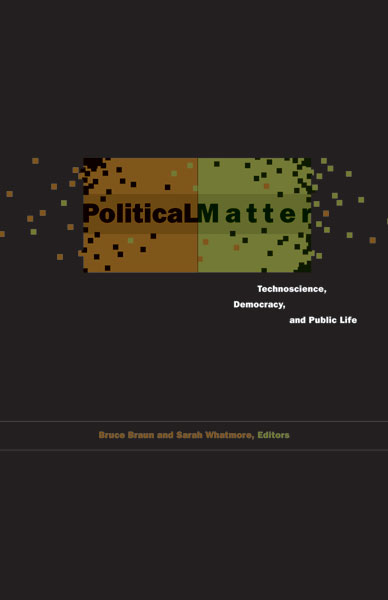
Political Matter

Political Matter
Technoscience, Democracy, and Public Life

Bruce Braun and Sarah J. Whatmore, editors
University of Minnesota Press, 2010

An engaging collection that explores the politics of material objects

Political Matter seeks to develop a fully materialist theory of politics, one that opens new possibilities for imagining the relationship between scientific and political practices. The contributors assert that without such a theory the profusion of complex materials with and through which we live—plastic bags, smart cars, long-life lightbulbs—too often leaves us oscillating between fearful repudiation and glib celebration.

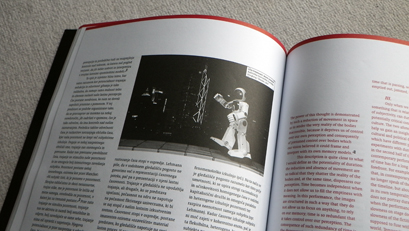
In his essay, Nigel Thrift writes about Ballettikka Internettikka.

Nigel Thrift:
Halos: Making More Room in the World for New Political orders
Page 139-174


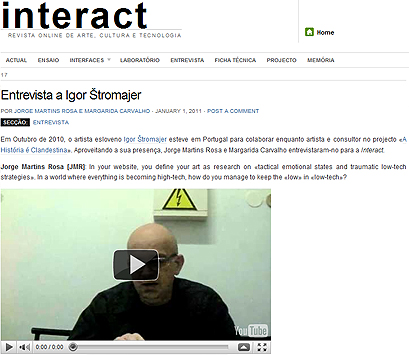
Entrevista a Igor Štromajer

Entrevista a Igor Štromajer
Por Jorge Martins Rosa e Margarida Carvalho
1 de janeiro de 2011

Interact
Revista online de arte, cultura e tecnologia, Lisboa, Portugal
# 17 (Secção:  Entrevista)

Em Outubro de 2010, o artista esloveno Igor Štromajer esteve em Portugal para colaborar enquanto artista e consultor no projecto “A História é Clandestina”. Aproveitando a sua presença, Jorge Martins Rosa e Margarida Carvalho entrevistaram-no para a Interact.

© Centro de Estudos de Comunicação e Linguagens, Lisboa, Portugal

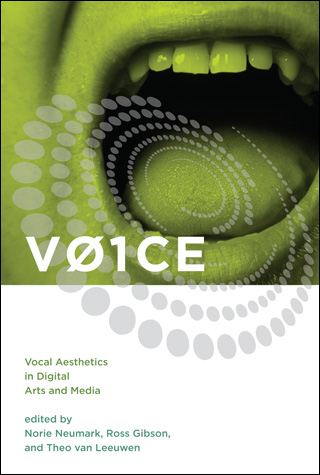
VOICE

VOICE
Vocal Aesthetics in Digital Arts and Media

Edited by Norie Neumark, Ross Gibson and Theo Van Leeuwen
The MIT Press, U.S.A.

Voice has returned to both theoretical and artistic agendas. In the digital era, techniques and technologies of voice have provoked insistent questioning of the distinction between the human voice and the voice of the machine, between genuine and synthetic affect, between the uniqueness of an individual voice and the social and cultural forces that shape it. This volume offers interdisciplinary perspectives on these topics from history, philosophy, cultural theory, film, dance, poetry, media arts, and computer games. Many chapters demonstrate Lewis Mumford’s idea of the “cultural preparation” that precedes technological innovation—that socially important new technologies are foreshadowed in philosophy, the arts, and everyday pastimes.

Chapters cover such technologies as voice mail, podcasting, and digital approximations of the human voice. A number of authors explore the performance, performativity, and authenticity (or ‘authenticity effect’) of voice in dance, poetry, film, and media arts; while others examine more immaterial concerns—the voice’s often-invoked magical powers, the ghostliness of disembodied voices, and posthuman vocalization. The chapters evoke an often paradoxical reassertion of the human in the use of voice in mainstream media including recorded music, films, and computer games.

Norie Neumark analyzes and writes about the Oppera Teorettikka Internettikka by Igor Štromajer.

Continue reading “VOICE”