
Jelka Šutelj Adamič, Delo, Kultura, 2. april 2014

[press, articles, papers, books, media, lectures, references]
Jelka Šutelj Adamič, Delo, Kultura, 2. april 2014
Curating Your Memory
Curating Your Memory is an evening about deleting, curating and dealing with big data on a personal scale.
V2_ Institute for the Unstable Media, Rotterdam
The Piet Zwart Institute, Rotterdam
V2_: Thursday, 28 November 2013 at 8 pm
French philosopher Jacques Derrida made the claim that ‘the mutation in technology changes not simply the archiving process, but what is archivable – that is, the content of what has to be archived is changed by the technology’. What he means is that the style of the content is transformed through new processes and production. Moreover, the relation to time and space created by the fact that within mere seconds one can reach someone in every corner of the world, has also affected the content. Of course this also effects power relations, decision-making and accountability. It is generally known and accepted that archives construct a specific account of history, many things end up in an archive, but even more remains outside, to be forgotten. Questions like who is in charge of an archive, who selects, and for whom is the archive, have been plaguing archives from the beginning. One could argue that the digital accelerates this process, so how to relate to this new situation? What is the value of digital memory and how to deal with big data on a small scale? These questions form the start of an evening with three perspectives.
With Robert Sakrowski, Dragan Espenschied and Igor Štromajer, moderated by Annet Dekker.
This public event is organised by Piet Zwart Institute, Dept of Media Design – Networked & Lens-Based, and made possible with the support of Goethe Institute and V2_.

Igor Štromajer presenting at the V2_ Institute for the Unstable Media, Rotterdam, 28 Nov 2013, Photo: Sakrowski
Un acuerdo que materializa lo virtual
Por: Roberta Bosco y Stefano Caldana
04 de noviembre de 2013
El Pais, El arte en la edad del silicio, Madrid, Spain
(authors write also about the work of Igor Štromajer)
↓
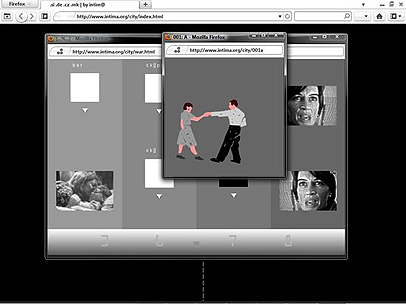
Colección Reina Sofía. “What was he thinking about? berlin? praha? ljubljana? skopje?” (2000) de Igor Štromajer.
+ read the entire article (in Spanish): blogs.elpais.com/arte-en-la-edad-silicio/2013/11/un-acuerdo-que-materializa-lo-virtual.html
Na razstavi Vmesna postaja 1 : 1 v MSUM o umetnosti v njenih realnih razmerjih do časa, življenja, ekonomije, politike in družbe.
– Maja Megla, Delo, kultura, 16. oktober 2013
“[…] Podobną postawę można dostrzec w grupowym przedsięwzięciu Performmikka Internettikka (2010), zrealizowanym przy udziale artystów takich, jak Annie Abrahams, Christopher Bruno, C. Dullaart, Robin Nicolas oraz Igor Štromajer i Brane Zorman. Performance, mający posłużyć jako eksperyment badawczy kontynuujący tradycje sztuki telematycznej, pozwolił twórcom na wspólne przedsięwzięcie pomimo dzielącej ich geografi cznej odległości. Wydawać się może, że sama koncepcja zdalnej współpracy była już dobrze rozpoznana przez działania takie jak The Last 9 Minutes (1977), czy koordynowane, globalne akcje Nam June Paika z lat osiemdziesiątych dwudziestego wieku, jednak w tym wypadku podstawową różnicą jest przestrzeń, w której pracują artyści. C. Bruno w akcji The Human Browser (2005-2013) wykorzystał zhakowany dostęp do treści pochodzących z Google. Performerzy, wyposażeni w słuchawki, recytowali teksty, które napływały do nich w czasie rzeczywistym, jako ciągi wyszukiwanych treści. Natomiast Igor Štromajer i Brane Zorman w projekcie Ballettikka Internettikka Insecttikka (2010) wykorzystali dwa samodzielnie poruszające się małe roboty-zabawki, rejestrujące obraz za pomocą wbudowanych kamer (vimeo.com/12187260). Materiał zrealizowano w porcie w Hamburgu, gdzie oba roboty, zaprogramowane na autodestrukcję, uległy zniszczeniu, co widzowie mogli zdalnie obserwować, stając się świadkami technologicznego „samobójstwa”. Oba roboty zatonęły w wodach zatoki, przekazując jeszcze przez jakiś czas obraz otoczenia i swoje wzajemne wizerunki. Materiał był dostępny dla widzów w formie transmisji. W tym wypadku performance miał charakter całkowicie zmediatyzowany, zarówno jeżeli chodzi o performera, jako o podmiot, jak i sposób odbioru performance przez publiczność, której zaprezentowano przekaz w czasie rzeczywistym, będący jednocześnie dokumentacją. […]”
Ewa Wójtowicz: RE-PRAKTYKI SZTUKI PERFORMANCE – DOKUMENTACJA, REMEDIACJA, DYSTRYBUCJA SIECIOWA, Sztuka i Dokumentacja N.9, 2013, Gdańsk, Poland / Polska
Igor Štromajer
M=5¦é×–0§ń $iá†
Published in: Theory and Practice in the Conservation of Digital Art (2013)

– reference: Expunction – Deleting http://www.intima.org Net Art Works
2011–1996
↓
I. ĆÓI#
BZh91AY&SY’˙K8# _¶˙˙˙ţ˙˙˙˙˙˙˙˙˙˙˙˙˙# ń’# ěµÎ? ýa “# 7Ĺčd# …÷Ő÷÷É# ¸# H# @HQR# =çŔ$_U9^# “Ŕ# € 0 “Ń{gśp# ĺ^# ¶ů¬ŰruHZ®Őlezn# ¸wsşűp+ŮM¶# ÷Ëď}ę1öw=ÝĹö7Ó” íZŕ ú >úú/w’)ľű=6h znMÇ# }áč# H$>ůî6’# # eÇ# ¸űť# Ôxú# “@)@. Ŕ# °#”Ęś úy>YV…# }Ě˝€# Ůô# Đ đún(# R©O #”ë*P*Š# ‘BT”¶†-X R¶4¦i@®ďy€ 8ô1Dŕ# I# # Z¨ş°ŐtÎŔ2# v4 P# ĄIJ *ŠTě Í°Bą¦# A¬# Š “C# čÔ% ŞR# [. Öñn# ” % # # RI “HE# # Ą6Ĺ+GqŽ°¶b-N’`TŽA’-˛H¤®*nÝË# # §fˇUŐ)¦€@# *# Ş)JˇF†ľ’-*uč# ™# “I# -N’Cl”¬ë’Ĺ]şéH”(: # Z# @# €# # # # # # # # # # # © M¶sŢ÷Ź™ęł>z
×’lëśßwp^Ů ßc# W¬Ýc}=ďnău¬ÝŐľ ďnÝB+Îč×Ö÷©÷ Ăč Đ6Ő€P# íŐ¦§]s[)m}=ăk{‘u¶é-ŁnŘß/{ˇóĺö /Žw’ů}óî]Í{Áť‡# Ó’}dH dA# P’°# -÷˝ărůµ U흼 =îÇÉč 駝s™Ý# ‘Ë5˘şĄ Ű-Żěďu# pŔ# ‘Řw]bűÝ “ď}7 “ú9f×Sî”-! “+q ą^őI[}vÝr “ĺn÷ Ľ# ÓŰŰ Ż7Ş5g4Ť# 0őÝc%ž# ‘Ź{# zM”¶ žl “# v:i*# p 4®ÚWs’VęÖ’Fť “M˝ď{Ó¸sëÁäzç} zŻsS§NůŚńŞ%z=t{Ĺź4$# ˇ@# čТ€H) P]e# †’B# Ćťë®IďwNë “DîŮ Î2P# €# Ă@ˇˇ ‘Š ¨ iˇ+[ŔĆ 0# ŽŞ…_©2ô†YCHâAĐ# ůđ‰R! h# ¨–‘)”˘!i# ĆÓI# # KXµ# …\d# äPŔt©’¤6Â’# Kď# ń˛# ‘I# \l “Q,At “ňÉBÜÍ%TD IQNŔ# -¦”bbJv-M¬# € Ä# ˛–H6-JĐspś “Đť°£Ä# gl# @a# # Ä# cÍ’˛ˇJ# ! cĚäŠGČÄTDM# L@PĐÄ# !# # D&Ĺ9Ť d¦¨§ó “ĚÓQ# # 튚# ÉC# # Ô$MÖ=ě# ŢĘS÷…O’# üś# ^cFoŃŚ îpPÄ# I@Rb# bĂHhX™b# 4¤i$”dwŰ# ž$# .‰˘# ăóy# # LJSATQI# # 7Ž# -j(”
Theory and Practice in the Conservation of Digital Art.
The Project digital art conservation
ZKM | Museum of Contemporary Art,
Espace Multimédia Gantner, Bourogne
CEAAC, Straßburg
House of Electronic Arts Basel
ISBN: 978-3-7091-1469-8
2013
Editor: Bernhard Serexhe
Publisher: Ambra |V, Vienna
665 pages, 174 images in color, 30 images b/w
Available at ZKM in English, German and French.
Includes contribution by Igor Štromajer, based on Expunction
– read the complete text by Igor Štromajer: M=5¦é×–0§ń $iá†:
Continue reading “Theory and Practice in the Conservation of Digital Art”
Surface Tension Supplement No. 6
Unsitely Aesthetics: Uncertain Practices in Contemporary Art
Edited and with text by Maria Miranda.
Unsitely Aesthetics seeks to address the unconventional ways in which contemporary art is made and engaged with across the vastly expanded networks of new media culture, arguing–counterintuitively–that network culture not only embodies its own version of “situatedness” but can also lead to the creation of a more democratic art, with the Internet acting as a far broader public space than the traditional site-specificity of old, a space in which artists can encounter and perhaps even engender new publics for their work. The book aims to theorize current dynamics in media and sound art practice, and includes interviews and conversations with Barbara Campbell, Linda Carroli, Hugh Davies, Bec Dean, Renate Ferro, John Craig Freeman, Jo-Anne Green, Teri Hoskin, Lucas Ihlein, Yao Jui-Chung, kanarinka (a.k.a. Catherine D’Ignazio), Scott Kildall, Deborah Kelly, Natalie Loveless, Michael Takeo Magruder, Timothy Conway Murray, Norie Neumark, Victoria Scott, Brooke Singer, Igor Štromajer, Helen Thorington and Darren Tofts.
Ballettikka Internettikka @ unsitelyaesthetics.com
Publisher: Errant Bodies Press, Berlin
Spring 2013
Pages: 292
ISBN-13: 9780982743980
Igor Štromajer interviewed by Dr Norie Neumark.
– barnesandnoble.com
– artbook.com
– amazon.com

Igor Štromajer
0§ń–M=5¦é× $iá†
On the project: Blank_Protest.
Maska Journal, Gestures of Resistance, Vol. XXVII, No. 151–151, Winter 2012, p. 98–105, editor: Martina Ruhsam.
Details + PDF: http://bit.ly/WYuZrk
Reference: www.intima.org/miat


 intima.org · Igor Štromajer